
Please email or call Treetec for a quote on Elm Leaf Beetle treatment.
 Treetec provides a range of services including soil treatment and stem / trunk injection. These treatments generally last three years and we offer a two year guarantee.
Where possible Treetec recommends the use of non chemical treatments and cultural methods for the management of plant pests and diseases. Where chemicals are used this should be a part of an Integrated Management System.
The person from Treetec who treats your tree will be a fully qualified arborist with chemical application certification.
Control Of Elm Leaf Beetle (Pyrrhalta luteola)
 The most appropriate Elm Beetle control depends on the season, degree of insect infestation, tree size, tree location / siting and philosophy.
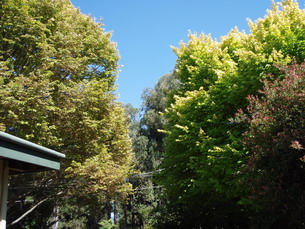
Elm Leaf Beetle infestation can defoliate a tree, if this happens continually the tree may die. Other factors such as drought, poor pruning / lopping or soil compaction will contribute to a decline in tree health. 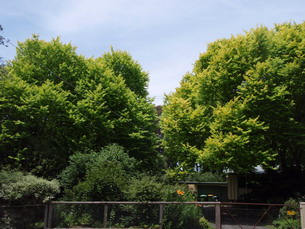 However one or two years of Elm Beetle damage or ongoing moderate damage is very unlikely to kill the host tree, unless there are other significant contributing factors.
Currently the most effective control measures for Elm Beetle involve chemical application. Generally trunk / stem injection or soil injection, both methods have advantages and disadvantages – there is more detail below. It is possible also to do canopy spraying however this is only suitable for some trees at certain times of the year and is more expensive in the long term.
 If you are considering having your tree treated it is worthwhile discussing with your neighbours (who own Elm trees) if they would like to have theirs treated at the same time as there are reasonable savings available when nearby trees are treated at one visit.
Note. Nearly all chemicals currently used commercially in Australia to treat Elm Leaf Beetle, regardless of brand name or delivery method, are neonicotinoid insecticides. this is the chemical type that was banned for all but a few specific uses by the European Union in 2013 and may soon be permanently banned across Europe. The ban is due to the association between the widespread use of these chemicals and the direct impact on bee populations and other pollinators.
 Elm Leaf Beetle further detail
To manage Elm Beetle infestation it helps to understand a little about the Elm Leaf Beetle life cycle.
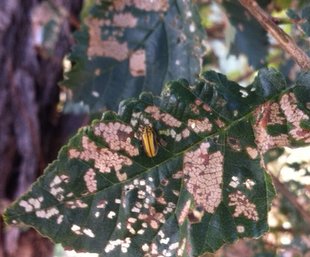
The Elm Beetles spend the cooler months in sheltered places such as wood piles, house eaves, cars & under bark. As trees come into leaf the Elm beetle emerges and flies onto the new growth where they begin to feed; they damage the leaves by eating small holes that look as though someone let off a shotgun through the canopy.
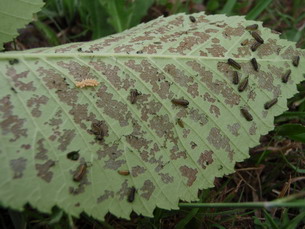
About November the Elm leaf beetles lay small yellow eggs usually on the underside of the leaf, then approximately 8 days later the eggs will hatch larvae (looks like a tiny shaved caterpillar). The Elm beetle larvae will also feed on the leaf but they eat the green material leaving a skeletonised appearance, they can trash a tree in just a few weeks. The larvae will go through a series of instars and moults where they progressively get larger (and more voracious). The mature larvae will then migrate down the trunk* and pupate into mature Elm leaf beetles, you may see this at Christmas or soon after. In southern Victoria there are usually 1 or 2 cycles per year
* Many of the Elm Beetle larvae will take the easy option and fall off the tree rather than use the trunk.
Controlling Elm Leaf Beetle
Unfortunately eradication of the pest is unlikely in the short term so the best approach is to look at long term management of your tree using an Integrated Pest Management (IPM) system. This involves planning, monitoring, taking action and evaluating the outcome. Generally it comes down to looking after your trees health as best you can, accepting that there will be some damage, minimising beetle numbers where you can and a stem injection application each 3 years (guaranteed success for 2), we give you a reminder call and arrange the treatment, if you leave it much longer than this, Elm leaf beetle population numbers can explode. This said if, in the third year, your Elm tree looks healthy and relatively uneaten then there should be no problem with delaying treatment for a 4th year – reducing chemical use and costs. If you do leave it only to find your tree getting badly eaten in spring it is not too late for an arborist to make a visit and treat the tree. You should monitor the tree for beetle and larvae numbers.
Soil injection
An insecticide is injected into the ground around the tree in multiple holes, the tree takes up the chemical through the roots and delivers it to the leaves where the Elm beetles and larvae ingest it. One treatment usually lasts for 3 years. Treetec offer a 2 year guarantee.
Stem injection / micro injection
An insecticide is injected (via multiple small drill holes) directly into the trunk of the tree, the tree transports the chemical to the leaves where it kills the beetle and larvae.
Further information on tree biology and drilling into tree trunks.
Foliage spray
An insecticide is sprayed onto the foliage, spray units can reach high into canopies and long hoses enable access to most trees. This application method results in significant over-spray, lasts for months only and we recommend against it.
Trunk banding, Trunk wrapping, Chemical banding
Stops the Elm Beetle life cycle as many of the larvae descend the trunk to pupate, there are a number of options both chemical and other.
Biological control
Use of natural predators of Elm Leaf Beetle; research by the applicable government agency into these options is ongoing, to date it has not been successful.
Extract from Friends Of The Elms Booklet
Principles of Modern Arboricultural Management.
Trees are living things and all arboricultural management practices should accord with basic biological principles. For example, any pruning activity should minimise the area of an open wound and capitalise upon the tree’s natural mechanisms of growing over and sealing off.
Trees are sophisticated organisms. Their large structures and longevity indicate a complex biology, efficient integrative systems and effective biological defence mechanisms. These defence mechanisms against pests and diseases are the strongest and most effective available. Arboricultural practices must never undermine, but rather complement them.
Stressed and aged trees have a reduced capacity for defence and so are prone to attack by pests and diseases. Their management often requires greater care than for young healthy vigorous trees.
Prevention is better than cure is the adoption of the medical model, which suggests that preventing structural deformity, disease or decay is a superior management approach than trying to remedy problems once they arise.
A non- or minimal-interventionist approach should be followed, which suggests that intervention in the natural growth of the tree should only occur through necessity, and under conditions where the biology and the physiology of the organism are understood to such a level that intervention will have clear and predictably beneficial outcomes.
All interventions must be done in such a way as to minimize the spread of pests and disease. This necessitates the adoption of basic hygiene when dealing with trees that have been attacked by pests or diseases.
Proper urban tree management is based on a sound understanding of tree biology that informs arboricultural practice (Moore 2004). There are basic principles of tree biology that are the foundations of modern arboricultural practice, and these are of greater significance when the trees concerned are either stressed or aged (Table 1). These principles must be considered when putting tree injection processes in context. Under these principles tree injection must be seen as an invasive process that inevitably wounds the specimen involved. Accordingly, the injections should only be used when other techniques have failed and should be seen as a measure of last resort for pest control or the improvement of tree health. With old or stressed trees there is a real risk that tree injection may actually make things worse for the specimen that you are hoping to treat, which is contrary to the principles of modern arboriculture. Consequently, tree injections must be seen as a part of a comprehensive pest control or tree management program. It should only be used when other measures have failed and when the benefits of injection can be shown to outweigh the risks to tree structure, vigour and health.
TABLE 1
| Common name | Species name | Susceptibility to Elm Beetle |
| English Elm | Ulmus procera | High |
| Scotch elm | Ulmus glabra | High |
| American elm | Ulmus americana | Moderate |
| ‘Homestead’ | complex hybrid including
Ulmus carpinifolia,U. hollandica, and U. pumila |
Moderate |
|
‘Liberty’ group American elms |
Ulmus americana selections | Moderate |
|
‘New Horizon’ and ‘Valley Forge’ American elms2 |
Ulmus americana selections | Moderate |
| ‘Pioneer’ | Ulmus glabra X U. carpinifolia | Moderate |
| Siberian elm | Ulmus pumila | Moderate |
| ‘Frontier’ | Ulmus carpinifolia X U. parvifolia | Low |
| Chinese elm | Ulmus parvifolia | Low |
| ‘Prospector’ | Ulmus wilsoniana selection | Low |
| zelkova | Zelkova serrata | Low |
Reference:
Moore G M (2004) Managing Aging Trees:
Implications for Tree Health. in Smith K (Ed)
Proceedings of the Amenity Tree Health Workshop.
Friends of the Elms, Melbourne.